
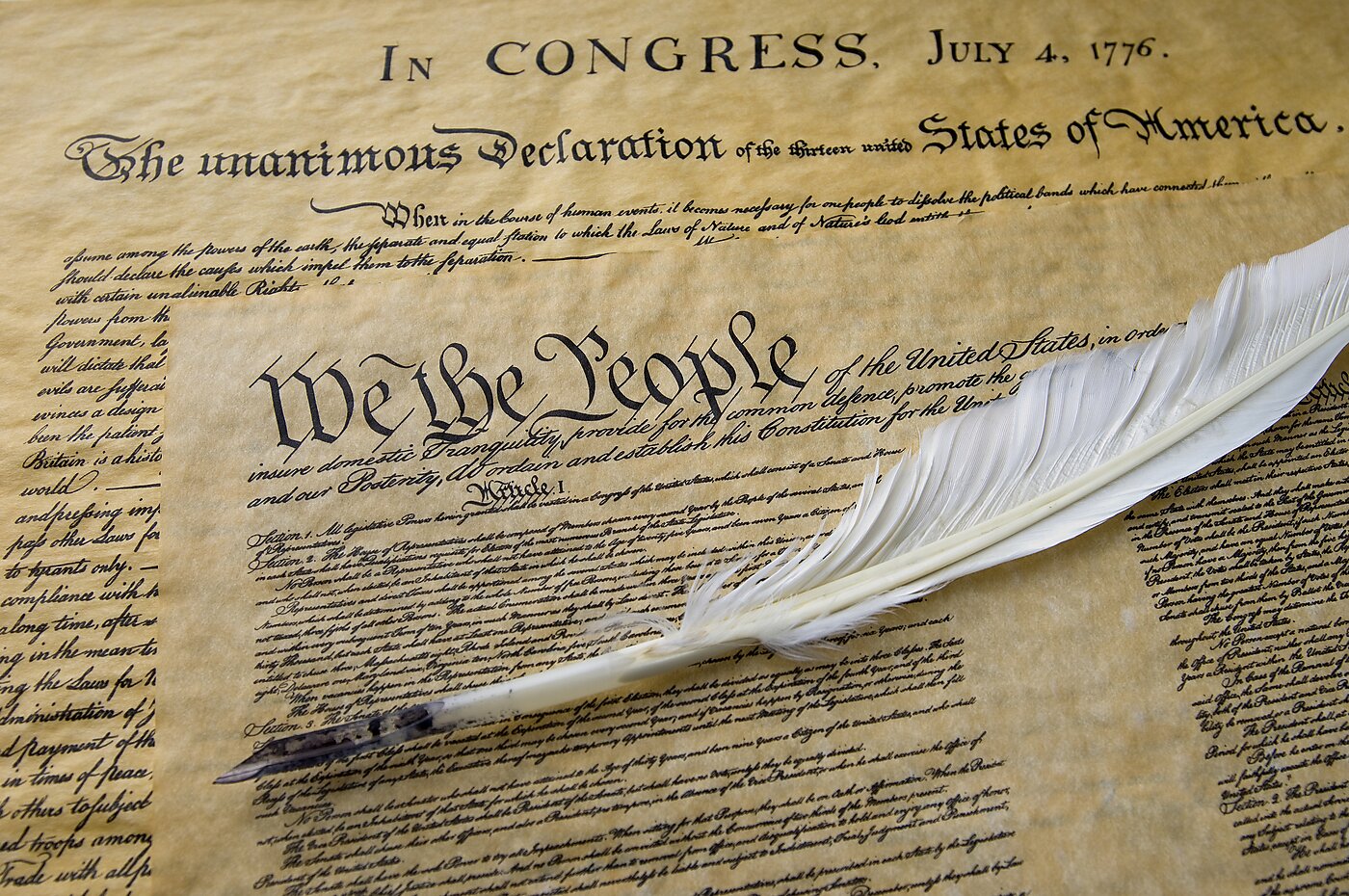
In anticipation of our nation’s semi-quincentennial, here are my reflections—some previously published—on a dozen key questions related to America’s founding documents.
1. What foundational political question did the Declaration and the Constitution seek to answer?
The essence of both documents is to establish the proper relationship between individuals and their government. The Declaration framed a two-part answer: First, government may not intrude on our unalienable rights to “Life, Liberty, and the pursuit of Happiness.” Second, the government may exercise only those powers to which we, the people, have consented.
Thirteen years after the Declaration was signed, the Constitution was ratified. Like the Declaration, it can be viewed through both a powers-of-government prism and a rights-of-individuals prism. The Framers viewed the powers of government narrowly and the rights of individuals broadly. In nearly all respects, personal choice is paramount—not coerced behavior.
Of course, choice must be exercised within a system based on the rule of law. Thomas Jefferson, in crafting the Declaration, leaned heavily on Thomas Paine, whose widely distributed pamphlet, Common Sense, was also published in 1776. Paine considered the central problem of governance to be authoritarianism, and the best fix to be the rule of law. He famously stated that “the law is king”; the king is not the law. The term “rule of law” encompasses a number of critical ingredients—the most important of which are clarity, stability, transparency, checks and balances, equality of application, due process, and the protection of fundamental rights. Those are the principles incorporated in the Declaration and the Constitution.
2. What common principles link the Declaration to the Constitution?
First, the Declaration: The cardinal truths, set out by Jefferson, are “that all Men are created equal,” with unalienable rights to “Life, Liberty, and the Pursuit of Happiness.” Ideally, no one should have rights superior to those of anyone else. We recognize, of course, that the atrocity of slavery was a conspicuous departure from that ideal. It took a Civil War to partially repair that odious exception.
Jefferson then continued: “to secure these Rights.” Notice, he didn’t say grant; he said secure; we already had the rights. The Constitution highlights that same theme when it refers in the Ninth Amendment to rights retained by the people. Naturally, we can’t retain what we didn’t already possess.
Jefferson next tells us that “Governments are instituted among Men, deriving their just Powers from the Consent of the Governed.” So, we were born with rights; we didn’t get them from the government. Indeed, whatever powers the government possessed came from us—from “the Consent of the Governed.” Our rights to life, liberty, and to pursue happiness require only that we respect the equal rights of others.
(Some persons have wondered why Jefferson referred to life, liberty, and the pursuit of happiness, rather than life, liberty, and property—a phrase that John Locke had used in his Second Treatise, on which Jefferson extensively relied. One possible explanation is that Jefferson wanted to broaden the Declaration’s vision and tie the nation’s founding to a universal aspiration rather than a parochial economic interest.)
When it came time to draft the new Constitution, the Founders’ task was to devise a government strong enough to secure our rights against domestic and foreign oppression, but not so strong as to be oppressive in and of itself. To achieve that goal, the Constitution granted to government certain powers, then checked and balanced those powers to prevent abuse. The rights were guaranteed, but the powers were limited.
3. Both the Declaration and the Constitution rest on an ethical framework. How do the two documents treat the relationship between political philosophy and ethics?
First, some definitions: Political philosophy deals with the relationship between individuals and their government. That’s the focus of both the Declaration and the Constitution. Ethics, by contrast, deals with values and virtues. Values are what we strive to gain and keep. Virtues are the means by which we seek those values. Clearly, ethics and politics are interrelated. Our political heritage is built on a system of ethical values—most particularly, the values of liberty and justice. But, for the most part, Americans treat our choice of virtues—i.e., conduct: good and bad, right and wrong—as private matters, limited of course by legal codes if and when such choices deprive other persons of their rights. The key point is this: Our founding documents are not codes of behavior that individual citizens must obey. The dual purpose of both the Declaration and the Constitution is to limit the power of government and secure individual liberty. It’s not the “people” or the “citizens” who are required to obey those documents; it’s the government.
To appreciate the gravity of that concept, just compare today’s headlines to the Declaration’s litany of complaints against the king. Jefferson wrote that the king has “cut[] off our Trade with all parts of the world”; “excited domestic insurrections amongst us”; “kept among us … Standing Armies without the Consent of our Legislatures”; “sent hither swarms of Officers to harass our people”; “Obstruct[ed] the Laws for Naturalization of Foreigners”; and “refus[ed] … to encourage their migration hither.” So, yes, it does seem both valid and timely to ask whether the ethical base for our politics and public policy is enduring or eroding.
4. The Declaration speaks of rights endowed by our creator. Can the reference to a creator be reconciled with the Constitution’s separation of church and state?
Jefferson and several other Framers were deists—meaning they believed in God as creator, but they did not impose on others the view that God controls our daily decisions or the recurrent operations of government. In fact, the Declaration speaks of both “the Laws of Nature and of Nature’s God.” For constitutional purposes, the key question is not whether our rights derive from natural or supernatural origins. Both the Declaration and the Constitution explicitly provide that our rights do not come from the king. Individuals have rights independent of government.
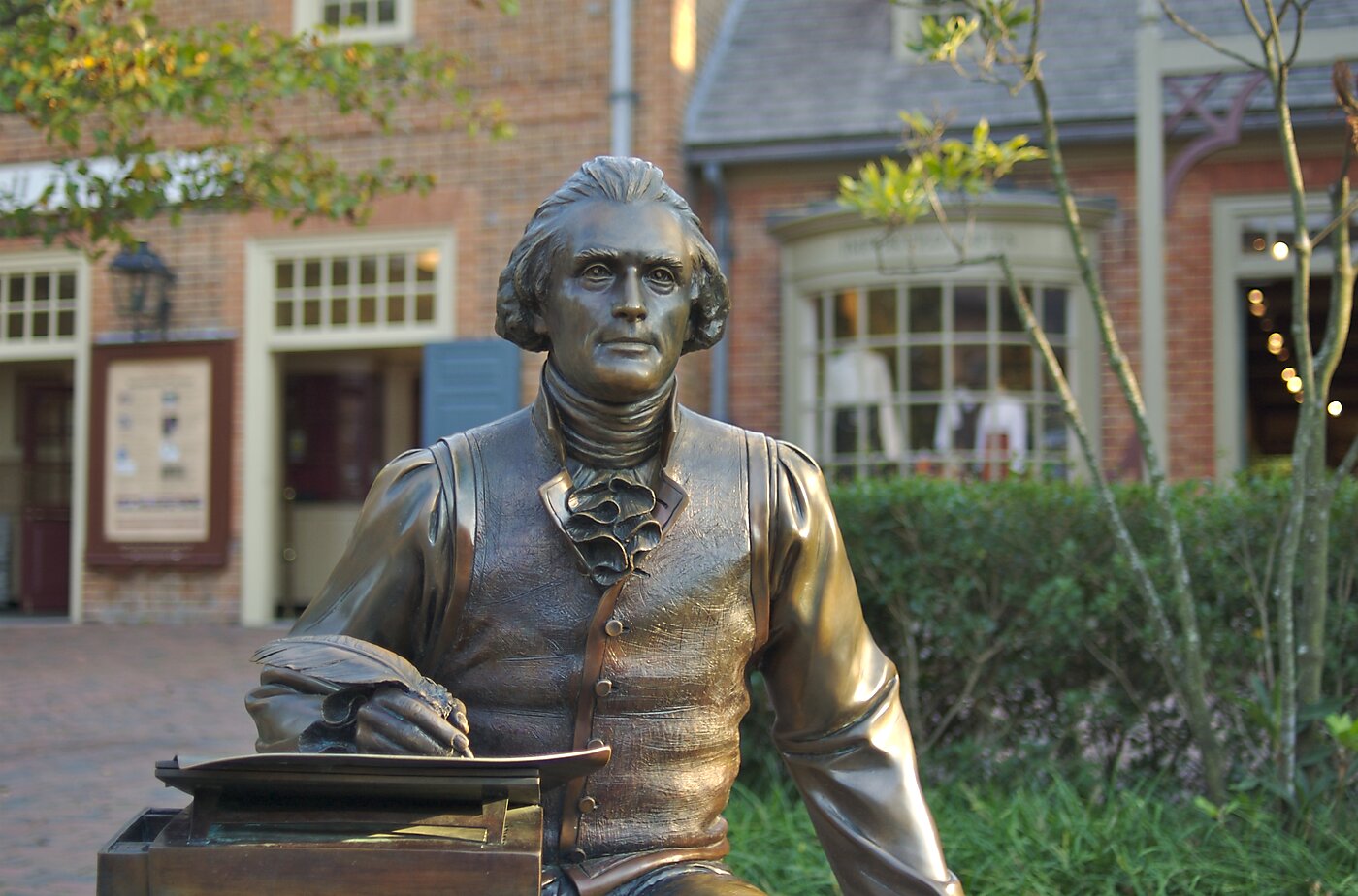
Jefferson’s initial draft said, “We hold these truths to be sacred.” Franklin insisted that the word “self-evident” be substituted, indicating that rights could not only be God-given, but also derived from reason. Put differently, the Constitution maps the relationship between Americans and their government. It does not mandate the relationship between Americans and their God. That’s up to each of us, individually. In a nutshell, we start with rights; then secure those rights by delegating limited and enumerated powers to a government bound by a written Constitution, which expressly protects religious and other liberties. Plainly, the Constitution does not insulate our lives from religion, but it does insulate our government from religion.
5. The Declaration was a manifesto for individual liberty, but the Framers didn’t craft a Bill of Rights until two years after the Constitution was ratified. Why wasn’t the Bill of Rights included in the original Constitution?
The Founders added a Bill of Rights as an extra precaution, even though James Madison, among others, initially thought that it was unnecessary. First, he argued that some rights—such as life, liberty, and property—were part of our natural rights and our common law heritage. We possessed those rights before the Constitution was written, and we never relinquished them. Second, other rights—such as free exercise of religion—didn’t have to be guaranteed because the Constitution enumerated the government’s powers, and the federal government had no enumerated power to control religious exercise. If there were no government power to restrict religion, then it wouldn’t be necessary to have a right that protected against such restriction.
Madison was also concerned that the listing of certain rights might be misinterpreted to mean that we didn’t have any rights that weren’t listed. Since it wouldn’t be possible to list each and every right, the Founders added the Ninth Amendment. It says that “The enumeration in the Constitution of certain rights shall not be construed to deny or disparage others retained by the people.” Those unenumerated rights—such as the right to travel, to cite one example—are protected even if they’re not expressly listed in the Bill of Rights.
6. The Framers could never have imagined what our 21st-century world would look like. And yet, over our 250-year history, we’ve had only 27 constitutional amendments—ten of which were the Bill of Rights. Why have there been so few amendments?
I suggest three key reasons for only 17 amendments in 234 years. Two of those reasons are good; one is not so good. The first good reason is that both the Declaration and the Constitution are incredibly well-crafted documents, written by brilliant statesmen who had a vision of liberty every bit as relevant today as it was in the late 1700s. The second good reason is that the constitutional amendment process is difficult. Two-thirds of both the House and the Senate propose amendments. Then they must be ratified by three-fourths of the states. Not surprisingly, that hasn’t happened very often, and, as a result, we’ve had a stable constitutional framework.
The not-so-good reason for so few amendments is that the Supreme Court has sometimes accomplished through the back door what Congress and the states couldn’t accomplish through the amendment process. Regrettably, the Court seems on occasion to have rewritten the Constitution by expanding government powers and failing to secure individual liberties. That, of course, is a topic for another day.
7. The Framers established a system of limited governmental powers along with expansive individual rights. How do those two features interact?
The structure of our federal system is best apprehended by the final two provisions of the Bill of Rights—the Ninth and Tenth Amendments, both of which were designed to implement principles initially set out in the Declaration. The Tenth Amendment tells us that the national government can exercise only limited and enumerated powers, which plainly excluded the “long Train of Abuses and Usurpations” listed in the Declaration.
The Ninth Amendment addresses rights, not powers. Specifically, it provides that the identification of certain rights in the Constitution wasn’t meant to exclude other rights, not specifically identified, including, as the Declaration prominently states, our unalienable right to pursue happiness.
Note that the presumptions underlying the Ninth and Tenth Amendments are exactly opposite. Indeed, that contrast captures the fabric of our founding documents. The Tenth Amendment says: if the power isn’t there, the federal government doesn’t have it. The Ninth Amendment is just the reverse: Merely because the right isn’t there, doesn’t mean we don’t have it. We have a broad range of rights that we possessed, pre-government and pre-Constitution.
8. The Declaration refers broadly to unalienable rights – including life, liberty, and the pursuit of happiness. The Constitution goes further and is more specific. Why was that framework adopted?
Yes, it’s true that the Declaration names only a few unalienable rights. It’s also true that the Constitution specifically identifies many other rights—mostly in the Bill of Rights. Remember, however, that the Declaration also contains a full 27 paragraphs, representing a “History of repeated Injuries” by the King. Those injuries are the basis for many of the rights secured by the Constitution. For example, the Declaration refers to the Right of Representation, the Administration of Justice, the quartering of troops, and Trial by Jury—each of which was later codified as a right guaranteed by the Constitution.
In other words, the two documents are directly linked, even though they served different purposes. The rights identified in the Declaration were those that the Crown had violated—listed to prove that the “Colonies are, and of Right ought to be, Free and Independent States.” Once independence had been assured, the Constitution was then crafted as the architecture for governing the new nation. The rights identified in the Constitution are not only those rights that the King had usurped, but all other rights essential to the preservation of liberty—including those not expressly enumerated but nonetheless encompassed by the Ninth Amendment.
9. It’s fashionable today to assert that America has lost its moral compass. Should government be empowered to enforce codes of moral conduct?
From its founding, America was an imperfect nation. Slavery was the most obvious imperfection. We’ve made enormous progress, despite the persistence of residual discrimination. Today, however, our critics point not only to racial inequities but to other problems, including what they broadly perceive as moral decay. As a result, both right-wing and left-wing zealots want to enlist the coercive power of government to compel moral behavior. But … unless an individual is acting in a manner that visits harm on innocent bystanders, coerced codes of behavior can themselves be counterproductive and even immoral.
It’s a short step down a slippery slope from government restrictions on non-injurious conduct to government restrictions on what I can read, with whom I can associate, what foods I can eat, what clothes I can wear, what I can say or write, and what religion I can (and cannot) follow.
Private lifestyle choices are the essence of individual liberty. A government-enforced code of personal behavior is antithetical to the freedom of choice. The principle is straightforward: We should be free to live our lives as we choose, as long as we don’t interfere with other people who wish to do the same.
10. Is it possible to reconcile individualism—as embraced by the Framers—with the need for cooperation to advance the common good in today’s complex world?
The Framers recognized the need for cooperation. Individuals can never be completely self-sufficient. That’s why we have rules to make peaceful collaboration and trading possible. Government is charged with enforcing those rules. The risk, however, is that too many rules will produce barriers to interaction and a system of special favors for the politically connected. Individualism, by contrast, promotes the common good spontaneously, as long as no commanding power interferes with freely chosen actions—unless, of course, those actions violate the rights of others. The empirical evidence is compelling: More wealth, including a greater abundance for the poor, is a by-product of individual liberty. And less wealth arises out of dictatorships on both the right and the left.
Individualism is not flawless. But neither are the alternatives. The relevant standard against which to compare our political and economic system is not a utopian world in which justice is ubiquitous and all inequities have been systemically purged. Instead, we should look at the American experiment versus one in which autocrats exercise power. Maybe a benevolent autocracy would resolve some problems, but other problems would likely multiply— including, for example, favors to special interests, government-conferred monopolies, restricted consumer choices, disincentives to create, reduced economic growth, overlapping and confusing laws, abuses of public power, and excessive resources devoted to politicking and lobbying. To be sure, individualism can be messy and unpredictable. But it’s the only arrangement consistent with liberty, which, to me, is the highest political value.
11. Individualism has been contrasted with majority rule. How are those two concepts harmonized?
In his book The Tempting of America, the late Judge Robert Bork discussed the so-called Madisonian dilemma. Bork wrote: “[I]n wide areas of life majorities are entitled to rule … simply because they are majorities. … [T]here are nonetheless some things majorities must not do to minorities, some areas of life in which the individual must be free of majority rule.” Judge Bork was clearly on to something. But, as my colleague Roger Pilon has written, Bork has blurred James Madison’s vision. The Founders instituted a plan of governance whereby, in wide areas of life, individuals rule—not because they’re part of a majority, but because they are born free. By contrast, majorities rule in just a few areas—not because they are inherently entitled to rule, but because they are authorized to do so by our Constitution.
12. What actions can individuals undertake to raise these issues for discussion and debate?
Individuals can make their voices heard. For starters, whenever an opportunity arises, discuss important public policy questions and shared values with your families, friends, and business contacts. Become active in public policy organizations; send letters to the editor; write to your political representatives; participate in meetings and rallies and protests; vote … and perhaps even become a candidate. Some voters are discouraged because their individual political impact may be minimal. One answer to that concern is to pool resources. There are numerous organizations—across the ideological spectrum—that analyze key issues, publish magazine and newspaper articles, appear on radio and television, testify before Congress and state legislatures, engage in public interest litigation, file friend-of-the-court briefs in major cases, and lobby federal and state legislatures and executive officials. Most of those organizations are funded by tax-deductible contributions. Whatever your political persuasion, they provide a means to leverage your influence and a pathway to secure freedom and democracy.
Happy Birthday, America!