
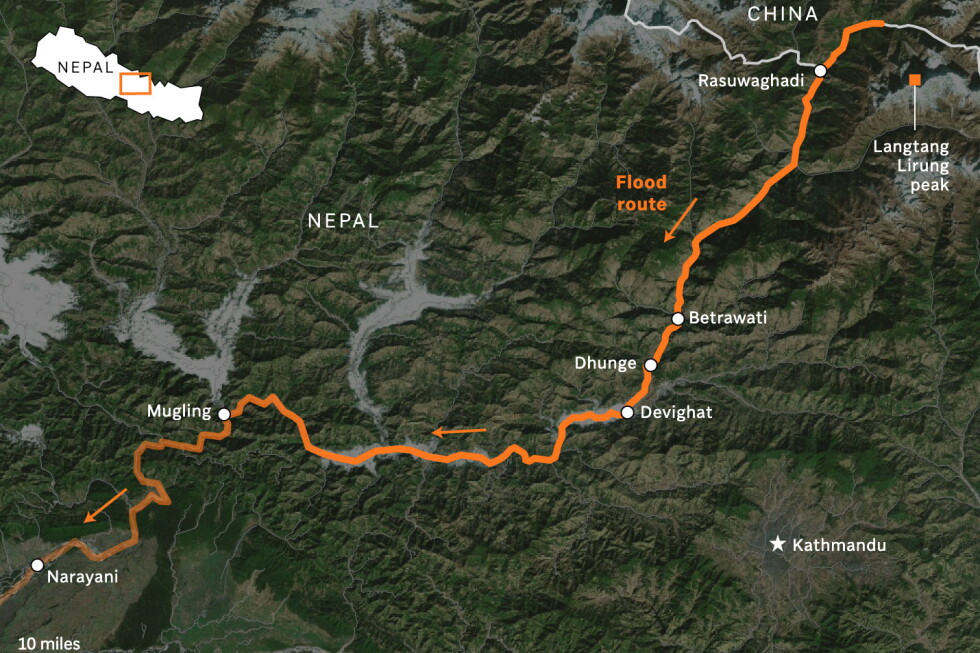
Rescue teams continue their desperate search for survivors along the border of Nepal and China following catastrophic flooding that claimed hundreds of lives on Wednesday. While ground crews navigate a landscape of ruin, earth scientists are utilizing satellite imagery to piece together exactly what triggered the disaster. Initial views were hampered by thick clouds and debris, but recent clear images have revealed a terrifying sequence of events originating from the Langtang Lirung peak.
Geomorphologists Kristen Cook and Dan Shugar discovered that the tragedy was caused by more than just a breaking glacier. According to Shugar, an associate professor at the University of Calgary, a massive section of the underlying bedrock actually collapsed, dragging a huge chunk of ice down with it. This colossal landslide sent a torrent of boulders and ice crashing into the valley below, creating a wall of mud and water several stories high that tore through everything in its path.
The aftermath visible from space is staggering. The Trishuli River has widened significantly, shifting from its usual green hue to a dark brown and black as it became choked with sediment and wreckage. Entire villages have been buried under layers of silt, leaving only occasional rooftops poking through the sludge. Even in Syapru Besi, a well known hub for trekkers, buildings were completely swept away by currents so powerful they actually pushed upstream into side rivers.
Experts believe these events may be warning signs of a changing planet. Alton Byers, a mountain geographer at the University of Colorado at Boulder who specializes in glacial hazards, noted that this is by far the largest glacier flood he has ever witnessed. He suggests that rising global temperatures are melting the permafrost that historically acted as a glue holding high altitude rock and ice together. While other researchers caution against linking this specific event solely to climate change without further data, they agree that such instabilities are becoming increasingly common in a warming world.